Project Overview
The Nevada Department of Motor Vehicles (DMV) website serves millions of residents seeking essential services such as driver licensing, vehicle registration, insurance compliance, and appointment scheduling. The existing site contained dense content, complex navigation, and accessibility barriers that made it difficult for users—especially those with disabilities, limited digital literacy, or time constraints—to complete tasks efficiently.
A key stakeholder requirement for this project was to increase adoption of online services and reduce dependency on in-person appointments. The redesign focused on guiding users toward self-service options whenever eligible, while still clearly supporting users who must visit a physical office.
The project aligned with federal ADA and WCAG 2.1 requirements ahead of the April 2026 compliance deadline.
Neveda DMV Website
Redesigning the Nevada DMV website to deliver a mobile-first, accessible, and online-first experience that reduces in-person appointments and improves self-service.
Launch Plan: A partial launch covering essential, high-traffic pages is scheduled for April 2026, followed by a full site launch by the end of 2026.

MY ROLE
Role: Senior UX/UI Designer
Platform: Web & Mobile
Tools: Figma, Miro,WCAG 2.1 AA
Timeline: 2026
Team: Cross-functional squad
(PM, Eng, UX, QA)
SUMMARY
The DMV website was reimagined using a task-first, accessibility-driven design system that actively encourages users to complete services online instead of booking appointments. The new experience reduces cognitive load, clarifies eligibility for online transactions, and promotes self-service through clear calls-to-action and progressive disclosure.
By prioritizing online workflows, the redesign supports both user convenience and organizational efficiency, helping reduce office congestion and wait times.
Problem
-
The original DMV website presented several critical challenges:
-
Users defaulted to booking appointments even when services were available online
-
Long-form content obscured online options and eligibility requirements
-
No clear distinction between online vs. in-person services
-
Accessibility issues created additional friction for users with disabilities
-
High-volume tasks (renewals, cancellations, address changes) required excessive effort
-
Limited mobile optimization discouraged on-the-go self-service
-
These issues increased appointment demand, staff workload, and user frustration.
Hypothesis
-
If DMV services are redesigned to surface online options first, clearly communicate eligibility, and remove accessibility barriers, users will:
-
Choose online services more frequently over appointments
-
Complete transactions faster and with fewer errors
-
Reduce unnecessary office visits
-
Experience a more inclusive, equitable service experience
This shift would directly support stakeholder goals by improving operational efficiency while maintaining compliance with ADA and federal standards.

Solution
1. Online-First Service Prioritization
-
Eligible services were intentionally surfaced with primary “Go Online” CTAs, while in-person options were positioned as secondary when required. This nudges users toward self-service without removing choice.
2. Card-Based, Task-Oriented Design
-
Services were broken into clear, scannable cards that communicate:
-
Eligibility for online completion
-
Required steps
-
Expected outcomes
-
This reduces uncertainty and increases confidence in completing transactions online.
3. Clear Online vs. Appointment Indicators
-
Each service clearly indicates whether it can be completed:
-
Fully online
-
Online with follow-up
-
In person only
-
This prevents users from defaulting to appointment booking.
4. Accessibility-First Implementation
-
The redesign follows WCAG 2.1 AA standards:
-
Proper semantic structure for screen readers
-
Keyboard-accessible navigation
-
High-contrast visuals and readable typography
-
Plain-language content for broad comprehension
-
Accessibility improvements directly support online adoption by removing barriers for users with disabilities.
5. Mobile-Optimized Self-Service
-
Given that 60.5% of users access the site on mobile, layouts, interactions, and content hierarchy were designed for small screens first. Online services were surfaced as primary actions, with appointments positioned as secondary when required.
Research Insights → Design Decisions
Rose–Bud–Thorn
Rose–Bud–Thorn analysis provided a high-level evaluation of the legacy experience, while affinity mapping was used as the primary synthesis method to distill research findings into actionable design themes.
Roses
-
Many services already available online
-
Trusted government source
Thorns
-
Dense content
-
Poor mobile usability
-
Accessibility gaps
Buds
-
Online-first CTAs
-
Card-based layouts
-
Clear eligibility guidance
.png)
Flow Chart

Before & After
Rose–Bud–Thorn analysis provided a high-level evaluation of the legacy experience, while affinity mapping was used as the primary synthesis method to distill research findings into actionable design themes.
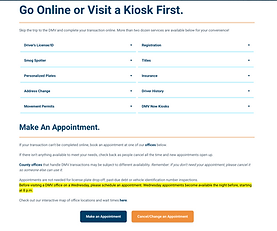
Before
The legacy DMV website relied on long, text-heavy pages that made it difficult for users to quickly understand eligibility, next steps, or whether a service could be completed online. Mobile users—who made up 60.5% of traffic—faced excessive scrolling, unclear navigation, and accessibility barriers. As a result, many users defaulted to booking appointments even when online services were available.


After
The redesigned experience is mobile-first, online-first, and accessibility-driven. Services are presented in scannable, card-based layouts with clear CTAs and explicit indicators for online vs. in-person completion. Improved content hierarchy, plain language, and WCAG-compliant structure reduce friction, increase online adoption, and help users complete tasks faster without unnecessary office visits.


What I’m Proud Of
-
Designing a mobile-first, accessibility-driven experience for a government platform where over 60.5% of users access services on mobile devices
-
Helping shift user behavior toward online self-service, directly supporting the stakeholder goal of reducing unnecessary in-person appointments
-
Translating complex DMV processes into clear, scannable, task-focused interfaces that reduce cognitive load
-
Embedding WCAG 2.1 AA accessibility standards into the design system early, rather than treating accessibility as an afterthought
-
Using research synthesis methods like affinity mapping to turn messy, real-world constraints into actionable design decisions
-
Delivering a scalable solution that supports a phased launch—with essential pages released in April 2026 and full rollout by year-end